
What Happens During a Bengkung Belly Binding Session
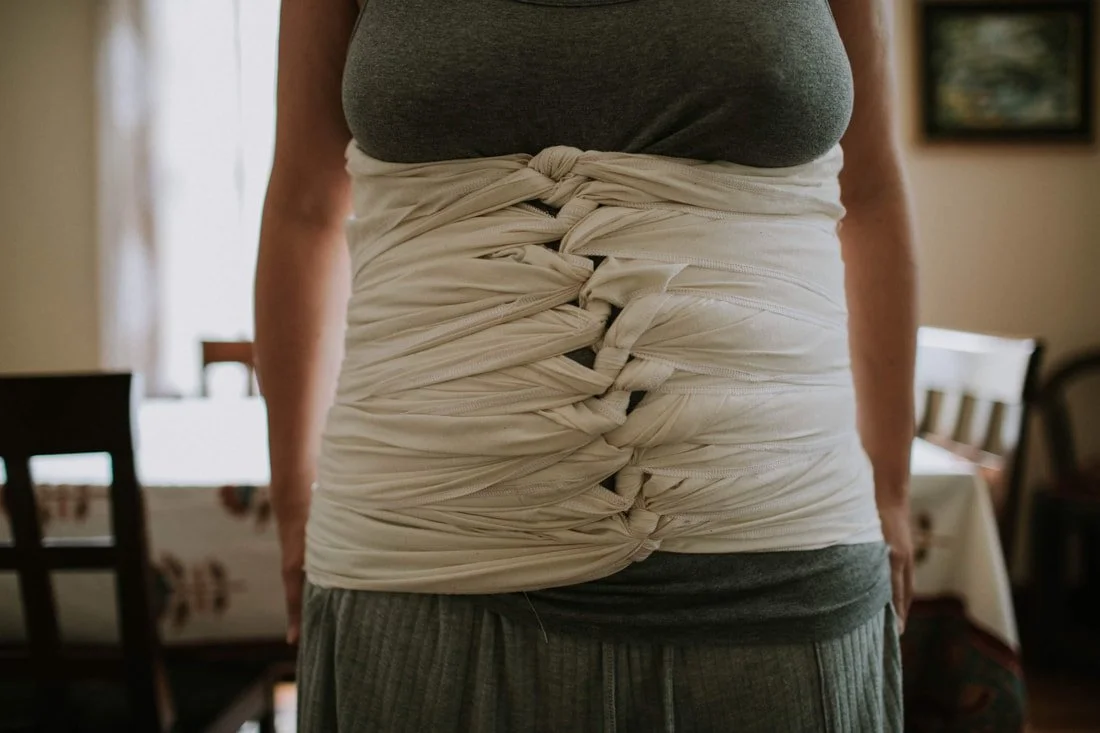
Most of the women I wrap have never seen a belly bind in person. They have read that it supports recovery, they have seen a photo or a short video, and then they arrive at the appointment with a reasonable question: what is actually going to happen to me for the next hour?
This post answers that. If you are considering belly binding as part of your postpartum recovery in Manhattan, here is exactly what a session looks like from the moment I arrive to the moment you rewrap yourself at home.
Before the first wrap
Every client starts with a conversation, not a cloth. We talk about your birth, whether you had a vaginal birth or a cesarean, how your bleeding and healing are going, and what your provider has said about your recovery so far. Belly binding is gentle, but it is still compression on a body that has just done something enormous, so your provider's clearance comes first. I will always ask.
We also talk about your goals. Some women want support for their lower back while feeding. Some want the feeling of being held together in a period that feels loose and unfamiliar. Some want help with posture because they are hunched over a bassinet in a small apartment all day. All of those are good reasons, and they shape how I wrap you.
What to wear and what to have ready
A comfortable bra. The first step is to add the protective layer of the belly binding cloth, running from your rib cage to your pubic bone. The wrap can be worn under clothes. It ends below the bust, and it is easier to wrap around a bra you are already wearing.
Underwear or shorts. The wrap starts at the hips, so the waistband needs to sit out of the way.
A place to sit for a few minutes. Choose a spot in your home where you can sit while I prep the area. This will take about 5–10 minutes.
A feeding or diaper break beforehand. We can pause for the baby at any time, but a fed baby buys us a calmer thirty minutes.
The wrap itself, step by step
Bengkung belly binding uses one long piece of cotton cloth, typically somewhere between 17 and 21 yards depending on your body and the length of the wrap. It is not cut, buckled, or fastened with hooks. It is one continuous cloth that gets folded, layered, and knotted down the front of your body.
Here is the sequence:
Positioning. You stand while I wrap. I check your breathing and make sure it is not labored. This ensures the wrap is applied safely and not too tight.
Starting the protective layer at the rib cage. The first pass goes around the rib cage. This anchors the whole wrap. Starting at the top matters, because the wrap is designed to lift and support forward rather than squeeze the middle.
Working upward in layers. I bring the cloth around your body in overlapping passes, moving up toward the ribs. Each pass is secured with a knot at the center front, which is why a finished Bengkung bind has that distinctive row of knots down the belly.
Adjusting as we go. After every few passes, I stop and ask two questions: Can you take a full breath? Does anything pinch? Tension is adjustable at every single layer, and I would rather rewrap a section than leave it wrong.
Finishing below the bust. The last passes end under the rib cage, and the remaining cloth is tucked or tied off so nothing dangles.
The sit test. You will sit down and breathe. Anything that feels wrong or too tight, or that affects your breathing, will reveal itself, and your wrap will be adjusted.
From arrival to finish, plan on about an hour for a first session. Much of that is conversation and teaching. The wrapping itself is faster once we find your fit.
What it actually feels like
The most common word I hear is held. Not squeezed, not braced, held. A correct Bengkung wrap feels firm and even from hips to ribs, and the support under your lower back is usually the first thing women notice. You should be able to breathe deeply, speak normally, and sit without the wrap folding or digging in.
What it should not feel like: sharp pressure anywhere, pins and needles, difficulty taking a full breath, pressure pushing downward on your pelvic floor, or nausea and reflux after eating. If any of that happens, the wrap comes off and we start again with less tension. Too tight is not more effective. It is simply too tight.
Wearing it, removing it, and rewrapping at home
I generally recommend wearing the wrap for a minimum of thirteen hours at a time and rewrapping every other day, with no more than a three-day break, since consistency is what makes binding worthwhile. Your own schedule may vary based on your birth and your provider's guidance.
Taking it off is simple. You untie the knots from the top down, loosen the layers, and unwind the cloth or step out of it once it is loose enough. Most women drape it over a chair, folded roughly in the order it came off, which makes the next wrap easier. You or your partner can also learn how to do the wrap, as there are different packages for different needs.
Between visits, you don't have to wash the wrap, but if you do, wash it gently as directed and make sure it is fully dry before the next wrap.
Quick answers to the questions I get most
Can I use the bathroom while wrapped? Yes. The wrap sits above the hips in a way that allows normal bathroom use.
Can I feed my baby while wrapped? Yes, and many women find feeding more comfortable with the back support.
Can I wear it while sleeping? Many women do, though comfort varies. Start with waking hours and see how your body responds.
What if I had a cesarean? Binding can be wonderful after a cesarean, but timing is different, and your incision needs to be healed and cleared first. I wait at least two weeks and always defer to your surgical team.
How many sessions do I need? Most clients start with five sessions, but the minimum is three. If you don't want full service, you can choose a single in-person wrap teaching session. Some book follow-up wraps for the comfort of having it done for them, which is its own kind of care.
Why this pairs so well with daytime support
It is a full-service session focused on postpartum recovery and support. I apply your wrap, you rest, and we focus on any other needs and questions you may have. If your wrap needs adjusting, I will be there to help.
If you are pregnant or newly postpartum in Manhattan and you want to talk through whether belly binding belongs in your recovery plan, book a free consultation and we will figure it out together.
This post is educational and is not medical advice. Always get clearance from your OB, midwife, or surgical team before beginning belly binding or any new postpartum recovery practice.
